Filmbox - Professional Film Emulation Plugin for DaVinci Resolve
Overview
Filmbox is a professional film emulation plugin for DaVinci Resolve that provides authentic motion picture film emulation with advanced processing and detailed controls. Built from empirical data to be an organic and comprehensive embodiment of photochemical imaging.
Key Features
Exceptional Accuracy
Built from empirical data to be an organic and comprehensive embodiment of photochemical imaging. Filmbox uses advanced processing to achieve an indistinguishable match to a negative's soft yet detailed character across its latitude and color response.
Color & Tone
Dense datasets are used to transform spectral radiance values from the digital image to match the film negative's complex response to those same light values across its latitude, along with its intricate interaction with print film — faithfully reproducing the combined response of a projected contact print on your display.
Grain & Texture
Filmbox reproduces the tonal distribution of grain across the density of each channel of the negative emulsion as well as the structural and temporal qualities and even subtle large-scale effects of the development process as sampled from real scans.
Gate Weave & Dust: Film transport mechanisms are not perfectly stable, and labs are not perfectly clean. If desired, Filmbox can model the subtle instability of real 35mm and 16mm cameras, and procedurally place samples of real dust.
Film Stock Library
Filmbox offers an extensive collection of film stocks across multiple photochemical systems。
Vision3 ECN-2
Kodak's modern motion picture negatives, ubiquitous in contemporary film cinema. Refined grain, amber halation, with color and tonal rendition that have defined cinema. Shown here as a contact print, but also available as a telecine-style transfer, log scan, or anything in between.
Bleach Bypass ECN-2
Motion picture negative processed without the bleach step to trap metallic silver in the emulsion. This boosts contrast, mutes colors, and enhances grain for a steel-toned look. Famously associated with films like Saving Private Ryan and Minority Report. Presented in 10 strengths. Looks especially good when paired with Scatter diffusion.
Ektachrome ECN-2
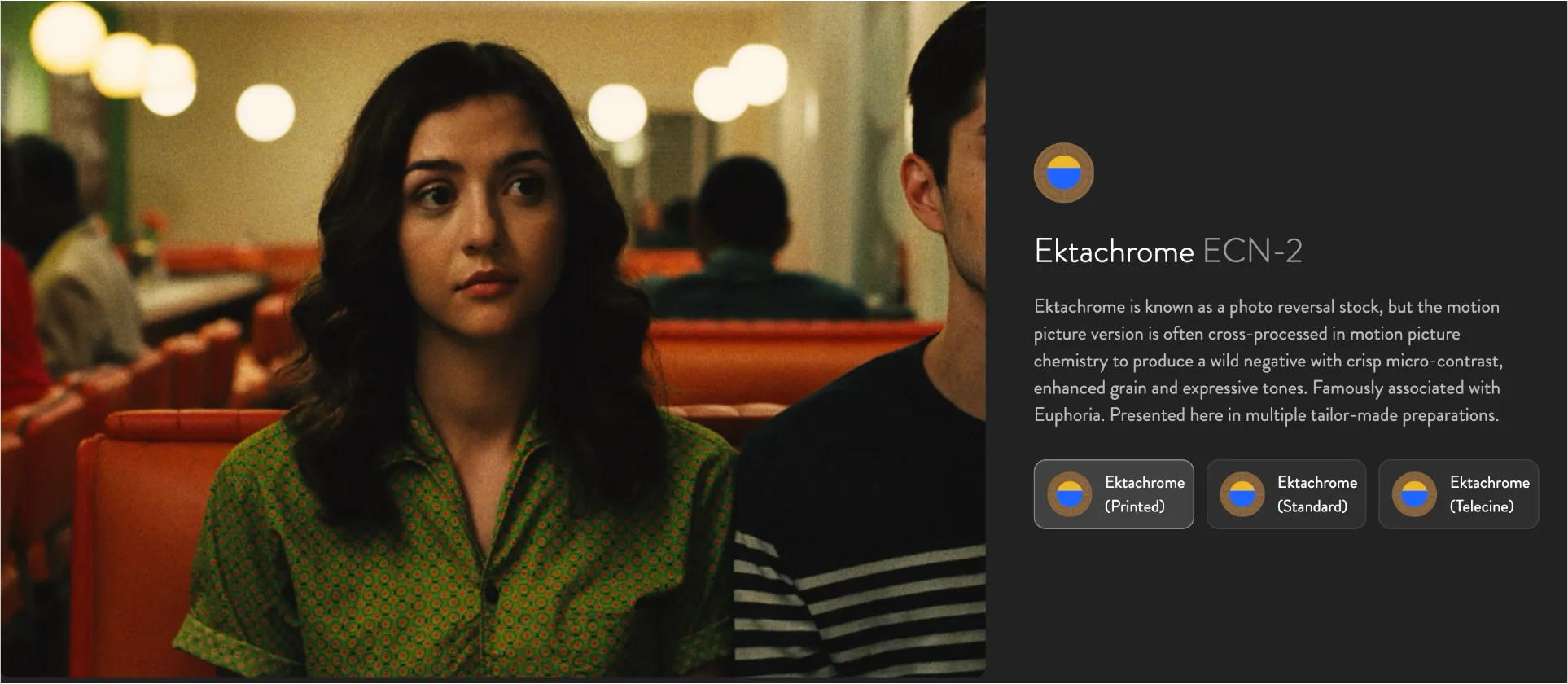
Ektachrome is known as a photo reversal stock, but the motion picture version is often cross-processed in motion picture chemistry to produce a wild negative with crisp micro-contrast, enhanced grain and expressive tones. Famously associated with Euphoria. Presented here in multiple tailor-made preparations.
Color Photo C-41
Still‑photo negatives spanning consumer and pro films that define the photo‑print look: from controlled tones of portra to the grit of street photography stocks to the amber aura of cinestill. Presented as a chromagenic print, or a lab scan or anything in between.
Vintage Cinema
30 Kodak and Fuji stocks discontinued between 199–2013; some look quite new, others have a strong patina. Each gives a unique take on the cinematic vernacular.
Reversal E6
E-6 reversal (slide) films don't involve a negative, they develop right into a projectable positive which we profiled directly. Reversal tends to have a clean look both spatially and tonally and especially neutral highlights and shadows. We also included a very fun reproduction of Instax instant film in here.
B/W Photo
Traditional silver-halide image-making from reportage to fine art: a diverse array of chromatic response, tonal separation, highlight aura, and spatial acutance.
Expressive Controls
Filmbox provides simple creative controls that tune the image like analog physics:
- Print Style: Each negative can be emulated as a print, or as a telecine-style negative transfer, or anything in between for dramatically different vibes.
- Gauge: The smaller the film, the stronger the textural characteristics. Choose between 16mm, 35mm, and VistaVision or configure your own.
- Acutance: Adjust local tonality and micro-contrast, analogous to lab techniques that influence fine texture and broader tonal separation.
- Push/pull: Simulates over- or underexposing a negative to produce different tonal and textural responses.
- Color density: Raise or lower the "brightness" of saturated colors.
- Vibrance: Increase or decrease the richness of color in a filmic way that prevents harsh colors and imbalanced skin tones.
- Contrast: A refined function that behaves like changing the gamma of the negative and avoids destroying shadows and highlights.
- Split tone: Push shadows and highlights toward opposing hues, as can occur when emulsion layers develop with unequal contrast.
- Printer Lights: Adjust the color balance of the image with controls that behave like analog printer lights.
- True Exposure: Exposure and color balance controls that behave like their on-set counterparts.
System Requirements
macOS
- macOS 10.15+ Intel & Apple Silicon
- DaVinci Resolve
Windows/Linux
- Windows & Linux require an NVIDIA GPU
- DaVinci Resolve
Version Information
Version: 3.2.4
Supported Platforms:
- DaVinci Resolve
- Baselight
- Adobe Premiere Pro
- After Effects
🐌Free Slow Download Links
This is a Premium Resources.
🚀Direct Download Link
Contact us on 💬WhatsApp for premium access and support.
Ref Link: https://videovillage.com/filmbox/