https://mononodes.com/color-shift-dctl/
LookAE source: 13-collection DCTL release
Overview
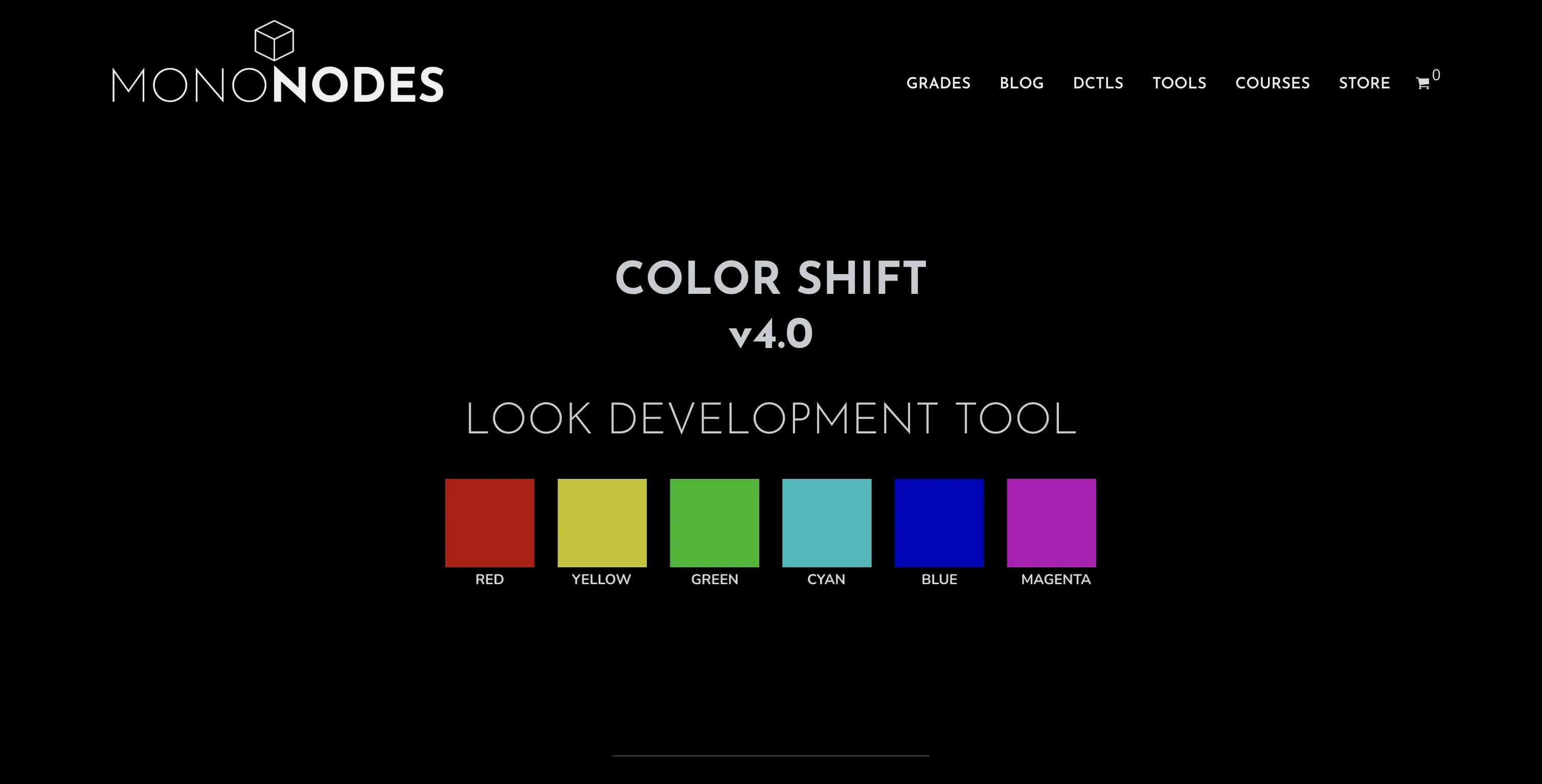
Color Shift is a look-development toolset created by Stefan Ringschwandtner (Mononodes) for DaVinci Resolve. It was inspired by the “Hue Shift” tool in FilmLight’s Baselight, which can shift hues towards adjacent colours. After that initial shift you can increase saturation, adjust brightness or desaturate specific hues. The tool focuses exclusively on the six main colours — red, green, blue, cyan, magenta and yellow — so it stays deliberately reduced and clearly laid out.
This bundle brings together 13 collections and 62 DCTL presets spanning Color Shift v4, v3, v2.2 and the Mononodes utility/shaper/palette sets. It is the official full version: no watermarks or black spots, with an official video tutorial (Chinese subtitles) and written installation instructions. DCTLs are designed for look development rather than corrective grading, prioritising flexibility and creative freedom.
Key Features
Six-channel colour control
Adjust density, saturation and hue independently for red, green, blue, cyan, magenta and yellow — useful for deep, film-style colours without the greying that comes from simple luminance reduction.
Spherical and Tetra colour models
Color Shift ships in two mathematical models. Files marked with T use the tetrahedral model; the others use a spherical colour model. Neither is better — they simply take different approaches, and each produces unique results. Version 4 includes 7 Spherical and 5 Tetrahedral DCTLs.
Density and saturation
The Density DCTL reduces luminance while subtractively increasing saturation to avoid greyish colours, producing the deep, saturated “film style” look. The Spherical model keeps saturation relatively stable while deepening the hue; the Tetra model links density with slight saturation changes for a richer, denser appearance.
Hue Range
The Hue Range slider controls how far a hue shift reaches into neighbouring hues. This is especially useful for yellow, which sits close to skin tones — a narrower range lets you saturate a taxi or a bright yellow skirt without disturbing skin between red and yellow.
Deep slider and Highlight Mode
Deep uses refined maths to define where in the tonal range saturation and density take effect, progressively excluding highlights as the value rises. Highlight Mode visualises exactly which parts of the image are excluded.
Skin tones
Version 3 used a dedicated Skin slider, but that isolated skin from adjacent reds and yellows and disrupted natural colour interaction. Version 4 takes a holistic approach: adjusting skin through the Red and Yellow vector controls gives smoother transitions and more cohesive colour harmony.
Node tree workflow and colour spaces
When stacking multiple DCTLs, arrange them in series — Density → Saturation → Hue. The tool works best in large colour spaces such as DWG, ARRI LogC3, ACES, REDWideGamutRGB and Sony S-Gamut3.Cine.
Included Preset Collections
MONO Color Shift v4 (with NE version + Chinese subtitle tutorial)
- MONO-1-DEN-v4.0.dctle
- MONO-1-HUE-v4.0.dctle
- MONO-1-SAT-v4.0.dctle
- MONO-2-SAT-DEN-v4.0.dctle
- MONO-2-SAT-RANGE-v4.0.dctle
- MONO-3-SAT-DEN-HUE-v4.0.dctle
- MONO-3-SAT-RANGE-DEN-v4.0.dctle
- MONO-T1-DEN-v4.0.dctle
- MONO-T1-HUE-v4.0.dctle
- MONO-T1-SAT-v4.0.dctle
- MONO-T2-SAT-DEN-v4.0.dctle
- MONO-T3-SAT-DEN-HUE-v4.0.dctle
MONO Color Shift v3 (with NE version + Chinese subtitle tutorial)
- MONO-SAT-DENSITY-T-v3.0.dctle
- MONO-SAT-DENSITY-v3.0.dctle
- MONO-SAT-HUE-v3.0.dctle
- MONO-SAT-RANGE-v3.0.dctle
- MONO-DENSITY-T-v3.0.dctle
- MONO-DENSITY-v3.0.dctle
- MONO-HUE-T-v3.0.dctle
- MONO-HUE-v3.0.dctle
- MONO-SAT-T-v3.0.dctle
- MONO-SAT-v3.0.dctle
- MONO-SAT-DENSITY-HUE-T-v3.0.dctle
- MONO-SAT-DENSITY-HUE-v3.0.dctle
- MONO-SAT-RANGE-DENSITY-v3.0.dctle
- PDF + Video tutorial
MONO Color Shift v2.2 (with NE version + Chinese subtitle tutorial)
- MONO-Brightness-v2.0.dctle
- MONO-Density-T-v2.1.dctle
- MONO-Density-v2.2.dctle
- MONO-Desat-T-A-v2.1.dctle
- MONO-Desat-T-B-v2.0.dctle
- MONO-Hue-Shift-T-A-v2.0.dctle
- MONO-Hue-Shift-T-B-v2.0.dctle
- MONO-Hue-Shift-v2.1.dctle
- MONO-Sat-T-v2.0.dctle
- MONO-Sat-v2.1.dctle
Additional Presets
- MONO Grid v1
- MONO SHAPER v1.0 (with NE version + Chinese subtitle tutorial)
- MONO PALETTE v1.0
- MONO Utility DCTL v2 (Chinese subtitle tutorial)
- MONO Utility DCTL v1.2 (Chinese subtitle tutorial)
- MONO Utility DCTL v1.1 (Chinese subtitle tutorial)
- MONO Hue Twist v2 (with NE version + Chinese subtitle tutorial)
- MONO Clamp v1
- MONO RGB Crosstalk v1 (Chinese subtitle tutorial)
- MONO RGB Split v1 (with NE version + Chinese subtitle tutorial)
System Requirements
- Application: DaVinci Resolve Studio 17 or higher (DCTLs are only supported in the Studio version)
- Platforms: Windows, macOS and Linux; tested with NVIDIA and AMD GPUs on PC and Apple M-series chips on Mac, via CUDA and OpenCL
- Minimum: Intel Core i7 / AMD Ryzen 7 / Apple M1, 16 GB RAM, 4 GB VRAM
- Recommended: Intel Core i9 / AMD Ryzen 9 or higher-tier Apple Silicon, 32 GB RAM, 8 GB+ VRAM
- Resolution: No restrictions
- Plugins: No third-party plugins required
- Size: 1.08GB
- Tutorials: Installation steps + official video tutorial (Chinese subtitles)
- Music: Does not include background music
Installation
- Open Project Settings in DaVinci Resolve.
- Go to Color Management and choose Open LUT Folder.
- Drag and drop the folders containing the DCTL files into that directory.
- Restart DaVinci Resolve for the changes to take effect.
Version Information
- Color Shift v4 — current release; 7 Spherical + 5 Tetrahedral DCTLs, Deep slider, Hue Range, holistic Red/Yellow skin-tone control.
- Color Shift v3 — introduced a dedicated Skin slider and the earlier Density/Hue/Sat set.
- Color Shift v2.2 — earlier Brightness, Density, Desaturation and Hue-Shift tools.
- Also included: Grid v1, SHAPER v1.0, PALETTE v1.0, Utility DCTL v1.1/v1.2/v2, Hue Twist v2, Clamp v1, RGB Crosstalk v1 and RGB Split v1.