
-
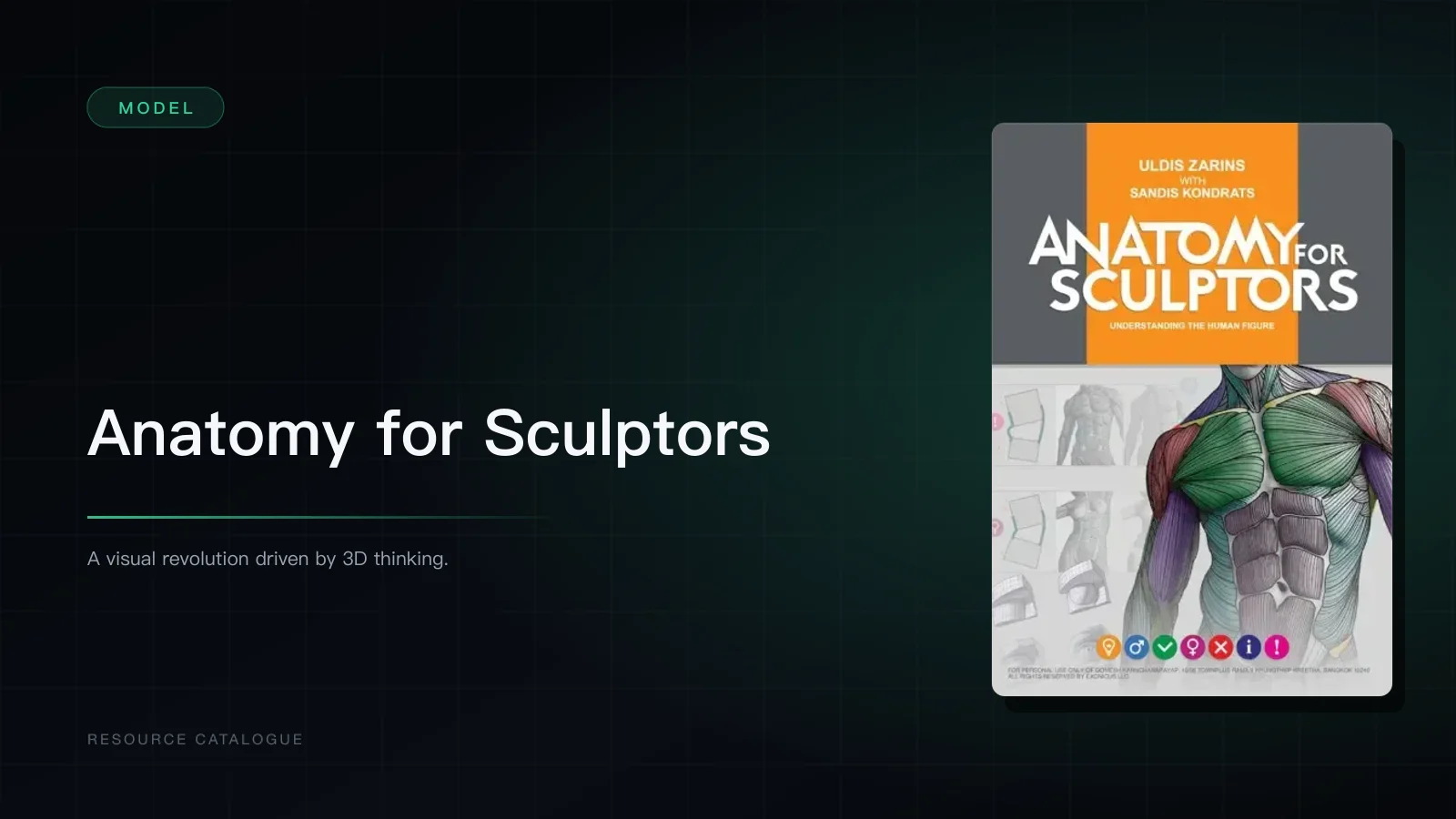
A visual revolution driven by 3D thinking Unlike traditional anatomy books that rely on static illustrations, this book uses 3D scanned models and dynamic pose sequences to show how muscle volume changes in motion. For example, when explaining arm flexion, it compares the surface bulge before and after the biceps contract and marks the occlusion relationship between “muscle masses” and bones — a “dynamic anatomy” perspective that is especially important for sculptors anatomy4sculptors.com.
-
An artistic approach to simplification The author proposes an “outside-in” observation principle: first locate the bones through surface bony landmarks (such as the clavicle and iliac crest), then connect muscle group functions with the concept of “muscle chains”. For example, the trapezius and latissimus dorsi of the back together with the gluteus maximus are treated as a single “posterior chain” to explain their coordinated action in twisting movements anatomy4sculptors.com. This method avoids piling up medical terminology and directly serves the needs of sculptural creation.
-
Practical tools validated by the industry The book includes supporting tools such as a proportion calculator and comparison charts of common mistakes. For example, for the “neck too thin” problem that beginners often run into, the book provides proportion formulas for neck diameter versus head width in men and women, and compares the volume difference between the wrong and correct cases anatomy4sculptors.com. In addition, the companion website (anatomy4sculptors.com) offers a downloadable 3D model library and weekly tutorial videos, forming a multi-dimensional “book + digital resources” learning system anatomy4sculptors.com.
Related articles

1000+ Fortnite Rigged Blender Models Download

259 High-Quality ASMR Sound Effects Field and Foley ASMR Essentials

4K Video Footage - 431 Sci-Fi Magic Energy Shockwave, Spark Particle, Dust and Smoke VFX Compositing Animations Infinity VFX